
Flexco’s FXC Revolutionizes Belt Changeout Process at Major Australian Iron Ore Facility
Industry
Application
Iron Ore Port
Product
FXC™ Steel Cord Belt Fastening System
Objective
• Connecting belts with different cord pitches and diameters
• Minimise maintenance downtime
Conveyor Detail
• Cord Pitch: 19.4mm & 12mm
• Cord Diameter: 7.6mm & 5.6mm
• Belt width: 1800mm
• Belt thickness: 29.6mm
Problem:
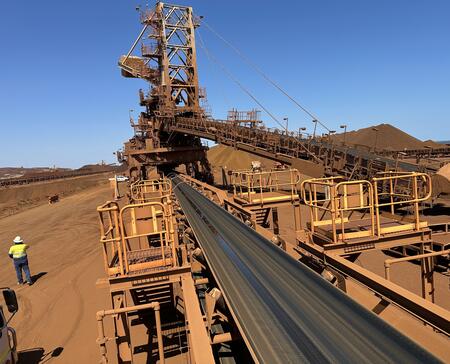
A major iron ore port facility north of Karratha faced a critical belt changeout involving 2 different belt specifications, a challenge that demanded a solution that was fast, safe, and engineered. The traditional dummy splice method would require 10 to 12 hours of downtime, and connecting belts with different cord pitches and diameters presented unique technical challenges. The Conveyor Specialist Engineer at the port had been considering alternatives for months to help drive the site’s initiative of decreasing downtime in a safe manner. The port facility regularly changes belts on their stacking conveyors due to cover wear and damage, but this time they were switching to a different belt specification to standardize to a more common belt type. The old belt featured a cord pitch of 19.4mm with a cord diameter of 7.6mm. The new belt had a much tighter cord pitch of just 12mm and a smaller cord diameter of 5.6mm. Both were rated ST2500 and measured 1800mm wide with a 29.6mm overall thickness, but internally they were completely different.
Historically, the port used dummy splices for belt changeouts, utilizing a generic vulcanized splice designed solely to withstand pull forces during the belt installation process. The connection only needs to survive long enough to get the new belt into position before being cut out and replaced with a permanent splice. This process was familiar to every belt splicing crew member on site. A team of 4 or more would remove covers, clean cords, layer in uncured rubber, and vulcanize the assembly. On an 1800mm wide belt, the process typically took 10 to 12 hours. That’s more than a full shift dedicated to creating a temporary connection. The bigger concern for the port was predictability. Most dummy splices lack official ratings, and their strength depends on multiple variables, including the skill of the splicers, the condition of the belts, environmental factors, and how well the vulcanizer maintains temperature. For connecting 2 different belt specifications, dummy splices become even more problematic because creating a reliable vulcanized connection between 2 belts with different internal structures is inherently difficult. Like most large-scale mining operations, the port strives to increase productivity and uptime, as every hour a conveyor sits idle represents significant lost revenue. A typical iron ore conveyor might move 3,000 tons per hour, and, at current prices, that translates to potentially hundreds of thousands of dollars per hour in lost production during periods of downtime. The Conveyor Specialist Engineer knew that the company’s upcoming belt changeout could take even longer than the usual 10 to 12 hours if they were stuck with traditional methods. Consequently, he began discussions with various solutions providers, ultimately meeting with Flexco and their distributor Fenner Conveyors to discuss the FXC™ Steel Cord Belt Fastening System. The FXC’s documented safety factors and potential time savings aligned with the port’s operational needs, so the port decided to trial the FXC for their next belt changeout.
Solution:
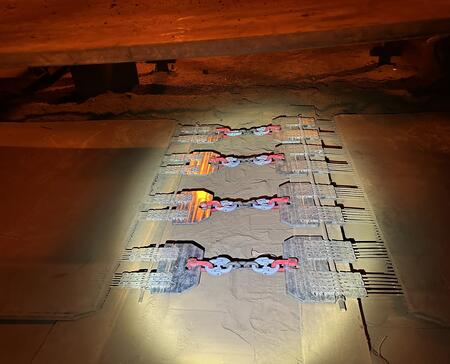
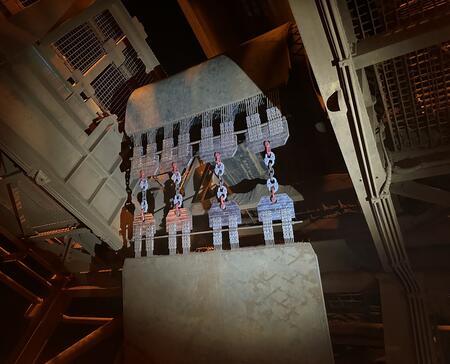
Working closely with the site’s maintenance team, Flexco’s engineering department developed a custom pull plate solution specifically designed to connect 2 belts with different cord specifications. The challenge was straightforward. FXC mechanical fasteners come in different sizes to accommodate different cord diameters and pitches. The new belt, with its 5.6mm cords, needed Size 1 fasteners, while the old belt with its 7.6mm cords needed Size 6 fasteners. These fasteners don’t mate directly together. Their customized solution used specially-engineered pull plates, allowing each belt end to get its appropriately sized FXC fasteners. Then, the pull plates would attach to those fasteners and connect to each other via industrial-grade, low-profile shackles and chains. The complete system featured 3 main component types. The FXC pull plate and joint assemblies provided a strength rating of 4.61 tons per assembly with a 3.8-times safety factor over the calculated peak belt pull requirement. With 4 assemblies on each belt end, the total strength reached 70 tons. Kupler shackles provided a 6-ton rating with a 4-times safety factor, while Grade 100 chain slings carried a 7.5-ton rating with a 4-times safety factor. The total pull strength requirement for the job was calculated at 18.32 tons. Every component in the system exceeded this requirement substantially, with the FXC connection providing 3.8-times the required capacity. This level of documented engineering gave the port confidence that the connection would safely withstand all pull forces during the belt changeout process and maneuver easily around pulleys and the 4 troughing roller setup
Result:
With both belt ends prepared, the crew used a crane to lift the old belt end out of the system and position it on top of the conveyor, requiring about 4 separate lifts. The belt end was fed through the 25-ton capacity pinch drive and attached to the powered belt reel system. The new belt end was pulled into the take-up area using a 5-ton capacity winch drive. Because the winch had only a single point of pull, the team used just the 2 middle pull plates with long chains to distribute the load evenly. The 24 ferrules attached to the 2 middle pull plates had a combined capacity of approximately 35 tons, providing a 7-times safety factor over the winch capacity. Once the new and old belts were connected, the belt crew positioned themselves at critical points as the FXC moved through the system. The pull plates, shackles, and chains transferred loads as anticipated, with every part performing exactly as engineered.
The crew completed both belt ends in approximately 6 to 7 hours of actual work, representing a 40% to 50% time savings compared to traditional dummy splices. However, the real advantage lies in advance preparation capability. The new belt end could have theoretically been prepped weeks earlier during normal operations at zero downtime cost, as only the old belt end required work during the actual shutdown window. With advanced preparation, the potential time comparison becomes 10 to 12 hours for a traditional dummy splice versus 2 to 4 hours for the FXC during the shutdown. That’s a 67% to 80% reduction in critical path downtime. The belt splicers who were initially hesitant about the FXC system were enthusiastic by the end and confident they could work faster on subsequent installations. The management team at the port now had documented engineering, proven performance, and measurable time savings, all of which were enough to justify initial and future investments. Based on the trial’s success, the port made an immediate purchase decision for another belt pull scheduled a couple of months later. Beyond this, other sites owned by the mine expressed interest in the system, and the port began considering replacing all dummy splices with FXC installations to achieve consistent, engineered approaches to belt pulls across all operations. The success came from documented engineering that provided credibility, custom solutions developed collaboratively for specific challenges, hands-on support during installation, and, most critically, a system that performed flawlessly under real loads. For mining operations facing tight maintenance windows and pressure to reduce downtime, the port’s experience demonstrates that Flexco’s FXC™ Steel Cord Belt Fastening System offers a proven alternative to traditional methods.
Product Group
- Belt Cleaning Systems
Product Line
- FXC® Steel Cord Belt Fastening System
Industry
- Iron Ore